
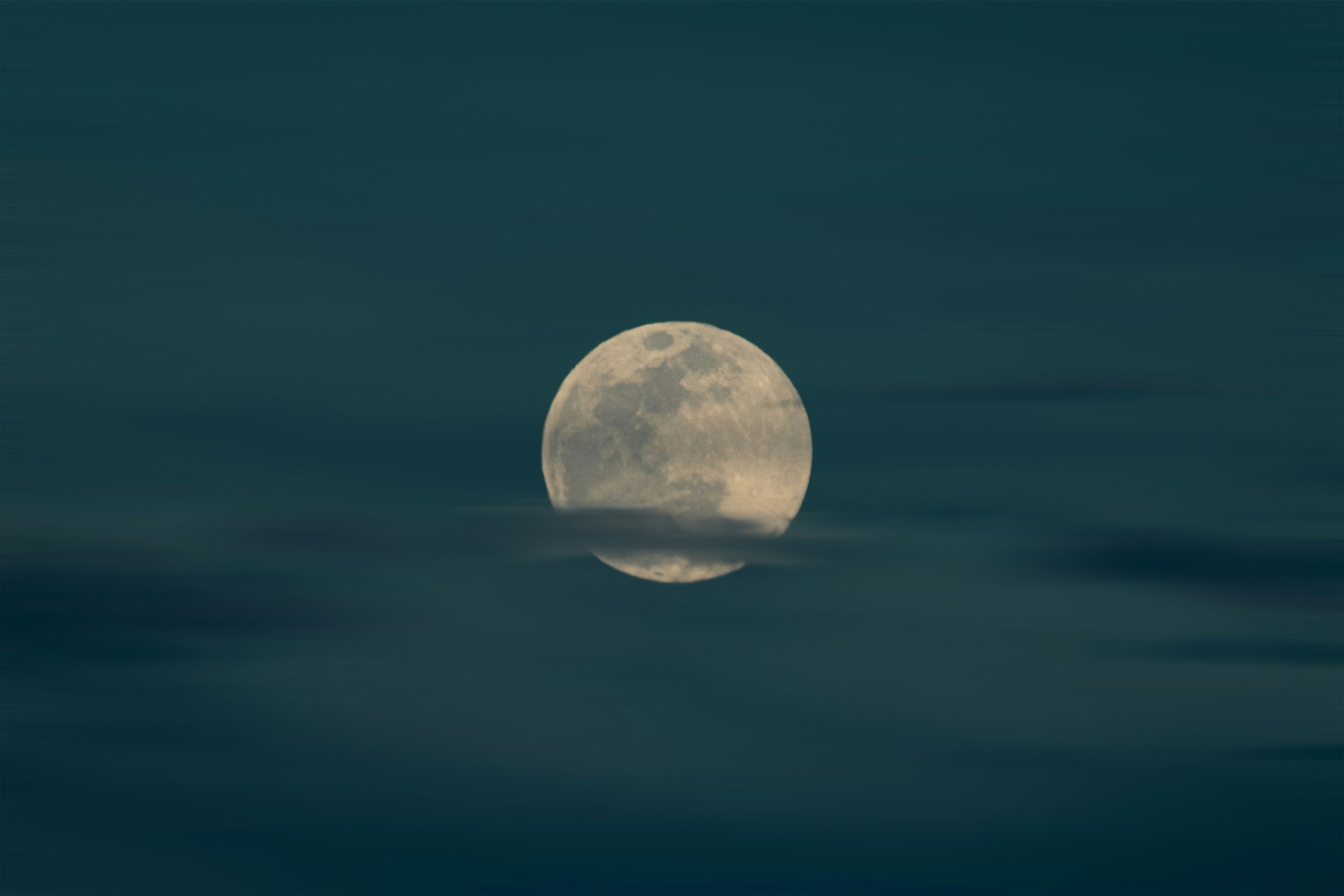
The moon gravitationally attracts ocean tides; that much is fact. Does it control animal migration, disturb your sleep, or induce weird human behavior, though? For centuries, people have reported seeing everything from unusual behavior to higher hospital admissions on full moons.
They’re largely myths, but researchers have discovered real effects of lunar cycles on biology and behavior that go beyond legend. The way the moon affects us beyond the tides is a testimony to insidious but constant forces on earth’s life.
Animal Behaviour: Slaves to Lunar Light
Hundreds of millions of species coordinate their lives with the lunar cycle, utilizing moonlight as a biological clock that has remained reliable for millions of years.
Caribbean and Pacific coral reefs mass-spawn at the same cycle of the moon, usually a full moon after the summer solstice. Corals coordinate reproduction during moonlight periods, maximizing fertilization. The timing is perfectly synchronized, allowing researchers to forecast events decades in advance.
Examples of moon-influenced animal behavior:
- Sea turtles coordinate hatching with new moons, when the night protects vulnerable hatchlings’ beach-to-sea journey
- Dung beetles exploit polarized moonlight orientation – one of the few insects to use celestial orientation
- Lion hunting is 50 percent lower on nights of a full moon, when prey animals would be better able to sense predators
Measuring nighttime activity of nocturnal insects that are decreased in full moons in light levels, which contributes to predator avoidance, based on Lund University, Dr. Eric Warrant.
The scale of moon cycles is being felt by whole ecosystems.
Read More: Why We Keep Watching Disaster Movies
Human Sleep: The Moon in Your Bedroom
Is the moonlight actually disrupting your sleep? Scientists believe so, but you can’t feel it.
Dr. Christian Cajochen of Basel University discovered, in a 2013 study published in Current Biology, that during full moons, subjects slept later, slept 20 minutes shorter, and experienced 30% less deep sleep, even in darkness and windowless rooms. They did not even look at the moon, yet their bodies reacted to the cycle.
Dark earth dwellings have more extreme lunar sleep patterns. Argentine Toba-Qom slept at various times by up to one hour during the lunar month and slept the most on nights leading up to full moons, when moonlight decreases earlier in the night.
The mechanism is unknown. Some researchers believe we have carry-over lunar phase-dependent evolutionary circadian programming. Others believe that lunar gravitational force controls unknown biological processes about which we know nothing. Light pollution masks these effects in today’s cities.
Read More: The Secret Symbols Hidden in Medieval Art
Full Moon Mythology: Bedlam and Crime
Police and hospital nurses attest that full moons are making bedlam. The record disagrees.
Many large-scale studies comparing millions of police records, hospital visits, and psychiatric emergencies found no association with lunar cycles. A 2019 meta-review of studies from the past 40 years concluded that the “lunar effect” on human behavior is statistically zero.
The myth persists due to confirmation bias; when, inadvertently, there happens to be a full moon night and people are out, they remember it if nothing strange happens. Full moon nights that don’t have any events scheduled are not marked. People are also retrocausally blaming unrelated incidents on something with no other conceivable motive than statistical likelihood due to the Barnum effect.
Even some studies indicate that rates of traumatic injury actually rise slightly during full moons, because people tend to venture out more, but not due to lunar causality.
The moon’s influence on us extends beyond tides to quantifiable biological cycles, such as sea coral spawning and sea turtle hatchlings, which are even divided into groups based on the lunar cycle by potentially coordinated turtles. Additionally, human sleep disturbance sometimes exhibits responsiveness to the actual lunar cycle. But the global mythology that humans lose their minds during full moons isn’t science. Light-dependent biological processes are affected by the moon, not mystical energy. Animals have evolved in response to persistent lunar cues over millions of years.
People still react vestigially to the cycles despite artificial lighting removing the effect from most. Next time you are complaining about sleeping loss due to the full moon, you are likely correct.
Read More: The Forgotten Jobs of the 1800s You’d Never Want to Do